
Why making the right choices in youth does not come without visible and invisible opposition
In the first blog post from discerningyouth.net we explored some prevailing trends and peer pressures that threaten proper, fruitful and joyful development during youth. A number of months later, at the start of A.D. 2026, this is the second blog post, hoping to delve into underpinning reasons for why avoiding these common mistakes can be so difficult. Perhaps surprisingly for some, the workhorse of opposing forces is mainly invisible to us. And it is personal.
Outcomes of these opposing forces are however visible in many cases, such as outworkings of hurt in relational interactions, influences of alcohol, or video- and image-based media, for example. However, the source is invisible.
What are these opposing forces? They are orchestrated by a fallen angel (evil spiritual force), known as Satan. In other words, the devil. Satan is the enemy, a personal enemy. We know this from the Bible, that he hates the good things God is doing, hates people being saved by Christ, and hates the world being run in ways honouring to the Creator God. To address this serious issue, we do have to accept a spiritual reality, that life is not just the material matter that makes up our bodies and the world around us. Pioneering scientists like James Clerk Maxwell and Michael Farraday knew this and openly acknowledged this reality. Clerk Maxwell put the words of Psalm 111:2 on the front door of the physics laboratory in Cambridge (the Cavendish Laboratory).
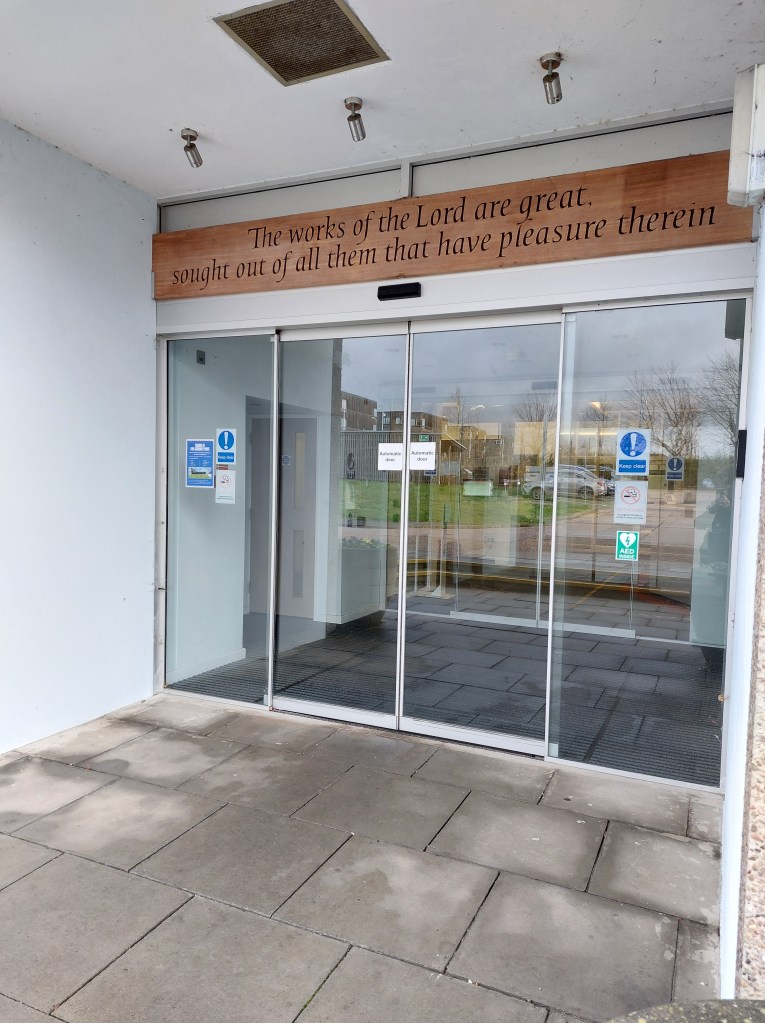

Why is there so much opposition, or at least indifference, to acknowledging God in scientific circles and university environments today? Precisely because of the opposing enemy mentioned above, invisibly injecting error and deception into once wholesome institutions.
We have a soul and that soul is eternal; furthermore, our physical bodies will be resurrected on the day the Lord Jesus returns. I ask and plead with you to not stop reading if you are not yet a Christian believer. God has placed good desires in those of us who do not yet believe because He loves us and wants us to be united with Him, saved from the hurt and turmoil around, happy in the beautiful design He has for the world. God wants to welcome us home! In 1 Peter 5:8-9, we read:
‘Be sober, be vigilant; because your adversary the devil, as a roaring lion, walketh about, seeking whom he may devour. Whom resist steadfast in the faith, knowing that the same afflictions are accomplished in your brethren that are in the world.’
[1 Peter 5:8]
The Lord Jesus, when He was walking the earth, referred to bad ‘weeds’ or ‘tares’ in Matthew 13:24–25 and 13:38–39 (the weeds = evil things and hurtful things) in the world amidst the good harvest of cereal grain (the grain = those saved in Christ, delighting in good, lovely and pure things, honouring to God), that will need to be removed on the day when He returns to bring in the harvest (the harvest = the bringing home of all God’s people, all of us who have placed our faith in Him) and make all things new (Matthew 13:29–30 and 40–43). All these hurts around us (be they from mistakes or innocently) are weeds, amongst the good and lovely things of life (in the beginning it was entirely lovely, and will be again in future) – these weeds were sown by an enemy, or in the Lord Jesus’ words: ‘an enemy did this’ (Matthew 13:28). Remember also, the enemy wants us to believe it is too late to turn back, to step onto the narrow path of life (see Blog Post 1 for more detail on what this narrow path is), but it is not too late yet. We mustn’t delay, but it isn’t too late yet.
We have now established that the source of opposition is a spiritual one, invisible to us because it is in the spiritual realm. However, the enemy does use visible vessels as part of his attempts to discourage, hurt and derail souls. Note that these are attempts. Satan is on a chain like a chained wolf or crocodile. He can do a lot of damage, but only what God Almighty permits him to do, and if God decides to reel in the chain, He can and will. God already knows how He will turn the devil’s pathetic schemes into good. God heals our spiritual and emotional wounds and even makes us healthier than we were before. We see this clearly from the Book of Job in the Bible, and you can see how the attacks are orchestrated by just reading the first chapter (with time, it is worth reading until the end, seeing all of Job’s hurtful trials and how God pulls through magnificently for him, vindicating all his mental and physical turmoil). Aside from the suffering of our Lord Jesus Christ by crucifixion, the suffering of Job is perhaps amongst the worst suffering recorded of people in the Bible. The visible vessels that Satan may use are often people who say or do something that targets something that hurts us profoundly or disrupts something immensely valuable to us. For example, Job’s wife tried to get him to curse God. Imagine, the one you love dearly, trust with all your heart, turns against you. This is the kind of pain we are talking about. There can also be physical, visual or audible factors that are used as ammunition to pollute our mind and lifestyle, even reputation.
All these factors can be directly linked to our own short fallings (sin) but not always, and this is an important distinction for which this article intends to focus on. Important to note is that all sin and evil is linked to the Fall recorded in Genesis in the Bible, where Adam and Eve were the first human beings to rebel against the Creator God, after which death and suffering came into the world. Remember this is history recorded in Scripture. Genesis is not a scientific textbook, but it is a reliable historical account. The author writes this as someone trained in biology and biochemistry.
Satan’s fall from heaven (becoming a bad fallen angel instead of a good God-worshipping angel) preceded the temptation and ultimate shameful sin of Adam and Eve. The Lord Jesus has defeated Satan by His death and resurrection two millennia ago (remember this is history, reliably recorded in the gospels, and even secular scholars do not doubt the existence of Jesus), so we need not despair, indeed we must rejoice if we are in Christ now. The devil is angry at his defeat and will be finally destroyed at the last day when Jesus returns. We must not underestimate his schemes even now which aim to hurt believers and prevent not yet Christians from becoming believers in Christ and living life to the full. If you reject Christ, consider what you are rejecting and why this is.
Essentially, there are two planes of Satanic attack that can come our way: one linked directly to sin (Plane I), but the other to do with targeted assaults on good desires and motives (Plane II). Sadly, this distinction is often not acknowledged by some ministers of the gospel and fellow Christians, despite the Biblical (e.g. Psalm 31, Psalm 41, Ephesians 6:12, Job 1:9–22, 1 Thessalonians 2:18) and experiential (experience in our own lives as Christians walking with God) evidence for this. Sometimes a mention of the spiritual battle can be met with an assumption that this always refers to merely sin, which, as we have here affirmed, is not the case.
Plane I: The battle with temptation
The first plane of spiritual attack will be familiar to all true believers in Christ but may not be fully perceived by those who do not yet know Christ or have not submitted their all to Him. When God is drawing us to Himself, one of the sure signs this is happening will be our realisation of the need to repent of shameful ways we tend to think with our mind, speak with our mouth and act with our bodies. Upon realising the warm acceptance by the Lord Jesus even while we are still sinners, our eyes are opened to the true reality: our only hope is through Christ who cleanses us by His blood (the blood shed when He was crucified, then defeated death by raising to life – remember this is history, not just a fairytale story). This free gift gives us genuine longing for the beautiful design for life here on earth, and into eternity in the new Creation. This is joyful and liberating, and the perspective from which this post is framed. Sensing, and being frustrated by, this spiritual battle, is actually reassuring for the Christian that we are indeed saved (converted and regenerated) and walking with Christ, desiring to live a holy life and growing in this day by day (this growth in faith and holiness is known as sanctification).
Two clear representations of this battle with the sinful nature are presented by the Apostle Paul in Galatians 5:16–26, Romans 7:15–25 and Romans 8:1–17, and directly by the Lord Jesus in Matthew 5:28–30. The way the Lord describes dealing with temptation now in the flesh is of course symbolic (we are not literally to gouge out our eye or cut off a limb, the language used in Matthew 5). We see the point he is making and the fact he mentions the eyes is noteworthy – we are to guard where we direct our eyes and towards what. In the age of excessive media and screens, including social media, films and the internet (which flood the next generation with depravity and bad examples), the inappropriate use of our eyes is a key target for the enemy. Beware, those of us in our youth.
To give a positive example of how to use our eyes appropriately: in the context of courtship and marriage, much can be positively communicated and reassured from the trustworthy and faithful locking of one another’s eyes, even without words. For a married couple to depart from the mutual embrace of body and eyes for too long is not healthy. Aside from the more obvious problems, social media can too easily and rapidly present issues in courtship development (even within marriage) that would not be there otherwise. These issues may involve trust problems and doubts based on lies of the enemy but could take various forms. To combat all these possible threats, the key is to focus on what is good, pure, lovely, and true, by God’s strength through constant prayer. Most importantly, keeping our spiritual eyes focused on Jesus and His ways, indeed His righteousness alone, is the essential cornerstone and overarching umbrella to pure and good living. God knows what is best for us and His plan will not be thwarted, no matter how hard the enemy tries to spoil good gifts!
In the Apostle Paul’s letter to the church in Philippi, written in the A.D. 60s, we read:
‘Finally, brethren, whatsoever things are true, whatsoever things are honest, whatsoever things are just, whatsoever things are pure, whatsoever things are lovely, whatsoever things are of good report, if there be any virtue, and if there be any praise, think on these things.’
[Philippians 4:8]
To keep us in the right mindset and on the correct path, we can pray silently at any time during the day as we walk around and even as we are in conversation. In the book of Nehemiah in the Bible, from around the 440s B.C., in chapter 2 and verses 1–5 Nehemiah said a brief prayer (presumably silent) in front of the King before he spoke to him. Primarily, we are to set aside times for focused prayer and Bible reading, like in the morning and evening (ideally also at lunchtime – at least we can remember pertinent matters silently alongside grace before our meal, which can also be silent). Without prayer and truly trusting in God, we are hugely vulnerable, completely deceived as an unbeliever, but very vulnerable even as a Christian. That said, if we do not really believe that God sees everything then we may still be very immature in our faith. We need not despair though – we just need to trust and believe, committing every step to the One who sees all. For many of us, the path to realising we are converted and regenerated can be a gradual one, but there can be very sudden conversion experiences like that of the Apostle Paul. If we are still living it is not too late to take a fresh start, but we do not know when we may be taken from this life or when the Lord Jesus will return. It makes no sense for us to delay for two main reasons: the first has just been mentioned; the second is that it makes absolutely no sense to keep wallowing in the mud or going down the raging river (prevailing trends of the world around us, prevailing media and world leadership), when we could step onto the beautiful narrow path that leads to life (see Blog Post 1). Why would we delay?
In our youth and when growing up, the evil one will try to catch us out in key areas to prevent us walking with God, especially areas we are weakest in. Common factors to beware of are peer pressures to get tipsy or drunk, peer pressures to lose our virginity or push inappropriate boundaries before marriage, normalisation of immoral behaviour in films (which leads to mimicking of these patterns in real life), social life pressures from university and nightlife environments, exposure to immoral material on the internet, social media normalisation and incentivisation, adopting impure conversational language obtained from peers and media, rebellion against well-meaning parents, secular ‘woke’ anti-Christian ideology taught in many schools and universities, and careerism and academic status pressures. These are just a few examples, but all of us have our own specific challenges. The sad consequences of many of these scenarios are often not appreciated until after having been lured into them – yet, magnificently, the Lord is able to rescue us even from these consequences. A most dangerous place to be is thinking that we do not even need rescuing (we all do – whatever mistakes we have made in thought, word or deed, to whatever degree), and worse still, trying to drag others into the same harmful patterns. The relative weighting any combination of these (or other challenges not mentioned) may have, will depend on our own specific circumstances and personality disposition. Common to all is the battle with temptation to think, say or do what we know is not right and is not good and pure in God’s eyes (nor our own if we truly see the blessing of Christian values).
Thus here we have Plane I of the spiritual battle, the battle with temptation.
Plane II: Opposing forces to wholesome desires and values
Now, we are not to dismiss the second plane of spiritual warfare. This includes some of the most crafty tactics deployed by our enemy. When faced with this kind of spiritual attack, we need to go promptly back to the Bible and prayer for encouragement and support. It is unlikely we will find anyone who will understand completely, perhaps only slightly, what we have experienced. The experience of Job is a classic representation of this, where he lost basically everything, including his wife, children, possessions and health. Job’s wife turned against him in the process, and afterwards certain friends tried to suggest the trials were his fault. This links classically to the point made earlier that fellow Christians often do not acknowledge this form of spiritual attack. There is a risk that advice from others, or the angle from which it comes, may incorrectly interpret what is actually going on and discourage us. This is why these attacks are so crafty. The same first line treatment for spiritual warfare linked directly to sin (Plane I) is of course the same (to go to the Scriptures and prayer), where we are to find forgiveness and restoration through Christ our mediator.
The Psalms are a wonderful store of treasure for empathy in any situation we may face in life. Believers throughout the ages, going back thousands of years, have prayed these prayers and sung these songs, while going through serious trials. Incidentally, this is also why singing Psalms in church is so important. Often the Psalm writer is even facing death threats. Many of them deal with repenting from sin, but certainly also from the sufferings that come from persecution and unprovoked assaults from the enemy precisely because they are doing good from a motive of serving God (this good can include the desire and action to repent of sin). In Psalm 41, the Psalm writer is wrestling with the pain of being slandered by people, even those who he considered his close friends. This is precisely the type of spiritual attack we are referring to in this second plane. We are referring to bad things that happen to, or are said of, people, because they walk faithfully with God. Essentially, it is an attack on what is good, the overarching aim of Satan, the devil. The ultimate good is God Himself. Good things, and good scenarios in this life, are honouring to God and He smiles upon people who embrace these good values through faith in Christ. The enemy hates this, and this is why he launches attacks (flaming arrows) at people who hold to these values (Ephesians 6:16; 1 Peter 5:8). These things considered, it is important to note that even bad times are under the control of God, which can be confusing in the situation and certainly for making sense of theoretically – take courage from the Scriptures, like in Job 1, knowing that the Lord is on our side and not against us. Nicely cementing this truth, the Apostle Paul in Romans 8:28, writes:
‘And we know that all things work together for good to them that love God, to them who are the called according to his purpose.‘
[Romans 8:28]
What form may these attacks take and how are they deployed? We have already touched on one, that of slanderous gossip or accusations. None of us are perfect, and the Christian of all people knows this about themselves and humanity generally. There may be a person known to us (or perhaps not known to us) who does not like God and Christian values, who the enemy uses (utilises as a vessel through deception and non-perceptible control) to launch a ground attack against a Christian believer, someone interested in seeking Christ or someone who is sympathetic to Christian values. They may actively look for a fault in the Christian and try to use that, twisting information if necessary, to accuse them of wrongdoing. This may be a good quality which is twisted into something that prevailing society may consider bad or could be a genuine fault that is capitalised upon. The outcome of such attack can take various forms to differing degrees.
Effect on reputation is an easy outcome because whispering gossip can propagate slander without the knowledge of the victim and without opportunity for defence. The victim may only perceive cold shoulders from colleagues, previous friends, or even strangers, depending on the severity and spread of the slander, unable to access evidence or to discern any reasonable way to enquire of the source. More serious outcomes could involve the authorities, in which case the source may be more obvious, and more accessible to correct, but which may result in legal proceedings, perhaps with a dilemma on whether to pursue any such proceedings. The Christian can find this particularly puzzling, since we are called to turn the other cheek yet still stand fast for what is true. To take a couple of examples from our day, there have been teachers who have been disciplined by teaching authorities for holding to ordinary Christian values for family life, or a chaplain of a school disciplined for teaching ordinary Christian values in a sermon. These values are beneficial for the upbringing of children and safeguarding, but teachers who seek to deliver a Christian education are increasingly under attack. Meanwhile, those who normalise and promote the teaching of transgender ideology or teach young people about sexual interactions (under a cloak such as ‘sex and relationships education’) are allowed to continue, even praised. These matters should be entirely for parents to carefully consider how to instruct their children and safeguard them in these areas. Those who suffer from unhealthy affinities (e.g. ‘transgender’ or consequences from being exposed to inappropriate sexualised things) should be gently helped with empathy, with encouragement that God has a beautiful plan for them as the person they are made to be. If this is you, you do not have to settle for what the world tells you is the right way – choose God’s magnificent way instead (Blog Post 1 may be of some help to understanding this).
Perhaps the worst kind of attack in terms of physical and emotional pain is that of murder (although attacking someone’s character or those precious to them, can have a murder-like effect in the emotional and societal realm), which is what has happened devastatingly in northern Nigeria, for example. We must urgently pray for the rescue of our brothers and sisters in northern Nigeria and other places where there are such threats of death for being a Christian from certain areas of society. Sadly, British media largely fail to acknowledge this Christian persecution. This incidentally links to another facet of the enemy’s schemes – the indoctrination of society with ideology opposed to Christian values, normalising unhealthy trends, all the while hiding what is going on with Christian persecution, alongside presenting Christian values as boring, oppressive or outdated; when, in reality, Christian values are good, joyful and pure, even for those who are not yet in the faith. We must not take it for granted how we are still largely free to maintain beautiful and peaceful Christian values in the UK as individuals and families without threat.
Scenarios involving gossip in school, university or the workplace are common. We must be strong, and if we find ourselves being disadvantaged either socially or in career because we desire what is good, we must rejoice and thank God. Don’t be discouraged when people speak bad of you because of these things, because of Christ or holding to Christian values. The Lord Jesus said that because the world hated Him, it will hate us too – but He assures us that He has overcome the world. Those of us who know it is right to wait until marriage for any kind of sexual interaction, keep going, don’t be derailed by those who make fun of you. Those of us who have made mistakes, we all have, don’t be discouraged by those who make you feel like you should just keep doing the same things rather than take a fresh start in what is good, right and pure. The Lord Jesus smiles upon you as you step away from danger and onto the path of safety.
In other scenarios, we may find ourselves trapped in our words or trapped in a context that makes us look like someone we are not, completely out with our control (or because of unwise decisions). The enemy may use this in attempt to bring us down. The Apostle Paul talks of something remarkably familiar in 2 Corinthians 6:8, when he talks of being considered a ‘deceiver’ or ‘imposter’, yet in reality being genuine. Go back to the Bible, pray to God. He hears us whether it is the middle of the day at school, university or work, or the watches of the night as we lie awake in fear or anxiety. Keep going, keep praying. In Philippians 4:6–7, we read:
‘Do not be anxious about anything, but in everything, by prayer and petition, with thanksgiving, present your requests to God. And the peace of God, which transcends all understanding, will guard your hearts and minds in Christ Jesus.’
[Philippians 4:6-7]
God has ways of vindicating us in these circumstances, in ways we could not even imagine. In Psalm 41, we read that God laughs at the schemes of the enemy. He knows exactly how to rescue us out of a trial of this sort. Even if such vindication doesn’t become obvious in this life, on the last day (the day when Jesus returns to make everything new forever) every knee will bow to Jesus and everyone will see what is true. The day when Jesus returns could be in our lifetime or after we have gone into the grave – Jesus said that only the Father knows the time when this will occur (Matthew 24:36) but gave detail of the event and the suddenness by which it will occur, like the flood of Noah’s day (e.g. Matthew 24:36–51). So we must be ready. On that day, every tear will be wiped away from all those who have trusted in Jesus and kept the faith. In Revelation 21:4, we read:
‘And God shall wipe away all tears from their eyes; and there shall be no more death, neither sorrow, nor crying, neither shall there be any more pain: for the former things are passed away.’
[Revelation 21:4]
The complexity of two-planed offensives
In this post we have sought to distinguish between the two planes of spiritual warfare that can come our way. Distinguishing between the two is important to ensure we respond properly and proportionally, identifying the source and form of deployment for what it really is. However, we must realise that this two-planed offensive is complex, integrated, and profoundly perplexing. We have to be ready to defend against both planes of attack, which could potentially assail us simultaneously. For example, we may feel weak following a short falling in a particular area of sin in our life (Plane I) and be on the mend, the Lord having lifted us up out of the mire. Psalm 32 begins and ends with encouragement, starting with, ‘Blessed is he whose transgression is forgiven, whose sin is covered.’ and concluding with, ‘Be glad in the LORD and rejoice, ye righteous: and shout for joy, all ye that are upright in heart.’. Then just as you are recovering, an attack comes in out of nowhere in the classroom or workplace where someone accuses us of saying something that could be considered offensive to others, something innocent regarding ordinary Christian values, but which has been weaponised against the Christian colleague or student. This is a two-planed attack, where the enemy has capitalised on the initial wound inflicted by the Plane I offensive by launching a flaming arrow in Plane II. Thus we must be on guard, especially during times when we sense God has blessed us with a special shower of blessing and peace, as this can often be when the enemy tries to launch a potent and crafty attack in attempt to bring us down. In the Apostle Paul’s second letter to the church in Corinth (A.D. 50s), we read in chapter 2 and verse 11:
‘Lest Satan should get an advantage of us, for we are not ignorant of his devices.’
[2 Corinthians 2:11]
If we may briefly apply the concept along a slightly different angle to the treatment of Christians by modern secular society. It often feels like the Christian believer is subject to more strict observance and scrutiny than others, as if people are looking to find fault more with Christians than others, like there are two tiers of behavioural expectations. To an extent this is appropriate because as Christians we are representing the name of Christ and He calls us to a holy life, and we will be called to account for how we have used the gift of faith He has freely given us. Knowing the negative and wide-reaching effects from the failing of a Christian publicly, our enemy is certainly very interested in engineering and fuelling the development of such a scenario. Be on guard, and remember the enemy wants to do all he can to prevent precious souls turning to Christ for the first time or showing any interest in the beautiful design He has for society and family life. Christian values are a prime target for the enemy currently because more and more people are seeing the safety and goodness of society returning to these values, amidst powerful leadership and institutions pushing ahead with laws and policies that represent the exact opposite. The Christian view is that all people should be treated with care and purity, regardless of background or whether someone is yet a Christian. Essentially, people are starting to see through the nonsense, seeing the danger for what it really is. The Psalm writer of Psalm 37, in verse 7, helpfully presents the situation of non-believers getting away with promoting bad things and bad attitudes to God, while the person who trusts God seems to suffer:
‘Rest in the LORD, and wait patiently for him: fret not thyself because of him who prospereth in his way, because of the man who bringeth wicked devices to pass.’
[Psalm 37:7]
Indeed, we are to rest in the LORD and wait upon Him, even when things seem hopeless.
Vitally important is to remember that God has ordained even these tough times and attacks from the enemy. He knew they were going to happen from before time even began. This can be a difficult concept for us to get our head around, but we must be encouraged by the fact that God really does know what we are going through and He is going to vindicate all His people. In the Apostle Paul’s letter to the Romans, written in the A.D. 50s, we read:
‘Moreover, whom he did predestinate, them he also called: and whom he called, them he also justified: and whom he justified, them he also glorified. What shall we say then to these things? If God be for us, who can be against us?’
[Romans 8:30–31]
The Lord Jesus Himself was subjected to Satan’s schemes – He was tempted (Plane I), magnificently succeeded in resisting, and was eventually betrayed by a previous friend and handed to the authorities for crucifixion (Plane II). Through His crucifixion and subsequent complete resurrection from death to life, He annihilated the devil, sentencing him to a final defeat on the last day (see history recorded in, e.g. Luke 24, 1 Corinthians 15:1–22).
For the time being, as mentioned earlier, Satan still goes around raging on a chain, but in complete control of God and with a pre-determined certain defeat in future (see again Revelation 21:4). Therefore we do not need to worry, and must keep trusting God that He knows exactly what is going on in our life. The Lord Jesus understands completely because He has been through it all Himself!
Effectively combating both planes of opposition
Having established that the Lord knows what we are going through and feels our pain, we can be absolutely certain that He will enable us to overcome the spiritual opposition we face. Young people growing up, you do not need to fear the peer pressures on the ground or via social media. So we haven’t seen that film, TV programme or recent ‘trending’ video. So what? We are better off for it – our minds have not been polluted by it, by God’s grace alone. Maybe we have seen it – in that case we can turn away, take a fresh start, and stand up for others who are made fun of for not knowing about certain immoral and unhealthy things. We haven’t done that thing that people keep talking about as if we are supposed to do that at a certain age – no, we were right to not do it. Perhaps we have done that thing and we know it was wrong and regret it – again, take a fresh start and stand up for others when they are peer pressured or made to feel inferior or uncool for not experiencing a certain thing that is not honouring to God and not in line with Christian values (ordinary pure values that used to characterise most of British society). Don’t believe the lie that there cannot be a fresh start and that you are too far gone. This is a lie – trust the Lord instead, who will surely guide us along paths of joy and peace.
In summary, twelve manageable patterns (not limited to) are suggested in our life to combat spiritual opposition:
(i) Start and end each day with a short Bible reading and time of prayer, pleading with God to protect us from all threats that may come our way, and particularly from any unexpected temptations or things that take us off guard. A wonderful Psalm to end the day immediately before sleeping is Psalm 4, which ends with, ‘I will both lay me down in peace, and sleep: for thou, LORD, only makest me dwell in safety.’.
(ii) For married couples and families, hold daily family worship in the home as a whole family, ideally morning and evening. This should not be burdensome but should be from a place of joyful expectation and thanksgiving that our Lord really does hear our prayer and the Word of God can really be trusted. From this point, the Lord will surely demonstrate these truths in our own personal experience as we seek the Lord and trust in Him as our only Saviour and protector. A simple suggested format for family worship is where the husband leads in a short opening prayer, then the family sing or say a Psalm together (the Scottish Metrical Psalms from 1650 are ideal for singing), then a reading from the Bible followed by a time of prayer where family members have the opportunity to offer up prayers to God. It is helpful if the husband can give a short devotional on the Bible passage, and children should always feel that they can ask questions about the Bible in the home and be warmly appreciated in doing so, and likewise with praying to God themselves whatever time of day or night it is. If things go well by God’s grace, these times will be looked forward to as a time of refuge with God from the busyness and pressures of the day. It is only the Lord’s doing if these patterns are established in harmony and joy, and parents can seek refuge in God if their children tragically rebel away from the Lord (again, it is only God’s doing if there is a genuine desire there). To those in our youth – if someone you are considering courting does not have any discernible desire to pray with you and your potential future children in any potential marriage, then this is a warning sign.
(iii) Write down key Bible verses that encourage us and carry these around with us so that we can read them when we feel discouraged (we can commit them to memory too), reminding us that God is on our side. For example, in Psalm 27:1 we read, ‘The LORD is my light and my salvation; whom shall I fear? The LORD is the strength of my life; of whom shall I be afraid?’
(iv) Choose your friends carefully. Be discerning in who you trust, and run away from those who tend to influence you to patterns and environments that are not good and pure. It can be difficult to unsee things or forget certain contexts, so it is worth avoiding people who try to introduce us to impure patterns for life (further details on this topic can be found elsewhere in this article, and particularly in Blog Post 1). It can be very difficult in our day, but try to find a trustworthy Christian friend (of the same gender) who we can talk and pray with whenever possible. Ideally we would know someone like this at our local church and hopefully within our family (sadly, this is not necessarily always the case).
(v) Guard your heart against social media, ideally avoiding it entirely but at least minimising its use and influence in our life. Avoid popular online ‘dating’ apps and sites completely. These are traps, and a haven for people who enjoy mind games and quick boosts to their ego, even predators, with potentially devastating emotional, spiritual and physical dangers. In God’s immense mercy, some people have found their wife or husband there (sadly, some nice people go on these platforms and need to be plucked out of the mess) but this is a direct intervention of God – they were given a fresh start, able to leave behind the dangerous place. The negatives overwhelmingly outweigh any anticipated benefits – any good requires a direct, near-miraculous, divine intervention (hence the topic of this blog post!). We all know this deep down. For related reasons, avoid nightlife environments (see Blog Post 1 for more details). Don’t put yourself at risk, and don’t hurt the one who truly loves you and is waiting for you, your future spouse, by being on these online platforms or in these environments.
(vi) Spend quality time with family. If our family does not influence along good paths, this becomes a rather challenging matter. In this case, we may have to retreat regularly to our room and pray to God, reading our Bible, perhaps listening to or reading an encouraging sermon or Christian book.
(vii) Listen to faithful sermons, attending a faithful church regularly. If our family doesn’t go to church or we have no Bible-believing church nearby, we can still listen to sermons online such as via sermonaudio.com or via church websites directly. There are also excellent Bible commentaries available. Some recommendations are provided in the footnotes of this blog post. If you are at university, it is worth going along to a local faithful Bible-believing church. It can be difficult to choose, and a general recommendation, subject to individual discernment in prayer, is given in the footnotes of this blog post. Listening to sermon recordings at home during the week can be immensely encouraging, and the author of this blog has found this pivotal in taking encouragement while walking the narrow path in a world increasingly against Christ and Christian values.
(viii) Read wholesome and pure literature. Ideally this will be mainly books and magazines which directly guide us and encourage us in living joyfully within the beautiful Christian values God has ordained. Various classic volumes can sometimes be meaningful in terms of understanding and studying English literature generally. Beware of being polluted by impure things read in books and seen in films, which can even be present in certain classic volumes. Beware also of impure adaptations or re-makes of good classics, such as film productions, plays or re-written books. The safest way is to avoid all TV (including ‘netflix’, etc.), films, social media, and such, at least until we have developed the discernment in knowing what is healthy or not. Some wholesome literature recommendations, subject to individual discernment and prayer, are given in the footnotes of this blog post. By keeping to pure literature and avoiding the prevailing trends in films and impure literature, you will be well ahead (in life’s journey by God’s grace, not in a superior kind of way), not behind as some may claim.
(ix) Write out a self-reflection from time to time and commit all life decisions to the Lord in prayer. The self-reflection could take the form of a SWOT analysis, listing out our strengths (S), weaknesses (W), opportunities (O) and threats (T). Out from this, we can evaluate prayerfully how the Lord may be asking us to address certain issues in our life and look forward to the wonderful plans He has in store. All life decisions we make, including daily decisions, are subject to the will of God. We should seek the Lord (searching the Scriptures and praying), to discern what He is calling us to. Faithful sermons and commentaries can be helpful here. Know that God has a good and perfect plan for our life, which will exceed all our limited views!
(x) Keep a clear mind and look straight ahead, being aware of potential hinderances and traps around us. Ideally it can be helpful to establish a routine of getting to bed early and early rising, particularly to make time for Bible and prayer before the day starts fully, but also to keep refreshed and clear-headed. That said, life can get busy and it is not always possible to get enough sleep. The Lord Jesus is recorded to have ‘had no place to rest His head’, at times retreating by Himself to rest, and the Apostle Paul talked of sleepless nights in the context of challenges in the Christian life. Prayer takes priority, so we can ask God to give us sufficient rest, and strength to keep going when things get tiring. We can also be more vulnerable to attacks from the enemy when tired, so this is also more reason to pray regularly.
(xi) Overlook insults. We may need particular strength from God to overlook insulting comments, remarks or perceived assumptions from others who do not appreciate our spiritual challenges or ordinary Christian values, perhaps unbelieving family members, colleagues or friends. It can be exceptionally challenging to hold the tongue from responding with frustration. Proverbs 19:11 and Psalm 37:8 can be helpful to guard against this.
(xii) Pray continually throughout the day, truly believing that God sees everything and is in control of everything. We can pray briefly and silently at any time of day or night – God hears us and is there for us.
Conclusion of the matter
In conclusion, seeking the Lord and embracing Christian values for life while still in our youth is the best decision we can make. If we desire to do so, this is the grace of God in calling us towards saving faith through Christ. This is not by our own strength, so we should give overflowing thanks to God that He has opened, or is in the process of opening, our eyes. In John 6:44, Jesus says:
‘No man can come to me, except the Father which hath sent me draw him: and I will raise him up at the last day.’
And in Acts 2:39, the Apostle Peter utters this encouragement:
‘For the promise is unto you, and to your children, and to all that are afar off, even as many as the Lord our God shall call.’
If we see the good in Christian values but do not see the need to seek Christ, we should realise that we will only be saved in the end and be brought into the new Creation if we accept Christ as our only Saviour. Take encouragement that you see why Christian values are good for society and individuals – this is a gift of God by common grace and is certainly a correct observation, indeed indicative of being drawn to Christ, so we must not stop at that limited view! We will only truly rejoice in life itself now in its fullness if we are in Christ – He is the Creator and Redeemer. Jesus longs for us to accept His hand in faith, as heirs of eternal life. We need to beware of the enemy’s two-fold attack on Christian people, Christian values and all who consider seeking the Lord. We can withstand these attacks through prayer, holding fast to the Word of God, and though we may be wounded, we will never be defeated if we trust in God. If we are in Christ, He will surely bring us safely home.

A prayer for deliverance and protection
Our Father in heaven, Creator God we pray, have mercy upon us, whether we know You yet or not, restore us unto Your own self before it is too late. Rescue families, rescue daughters, rescue sons, rescue precious souls across this land and beyond. Lord Jesus, wash us clean by Your Blood shed on the Cross, by Your merits alone. Oh, how overflowing with joy we would be in Your presence with a fresh start, washed clean from all our shameful rejections of You, embracing Your beautiful and pleasant pastures of life from now onwards.
As we trust in You, Lord, and walk with You along the narrow path You have marked out for us, please protect us from all the attacks of the enemy and protect our friends and family too. Thank You that You have a wonderful and perfect plan for our life and we do not need to fear, even when things get difficult.
We pray all these things through the merits of Jesus Christ our Lord, closing with Your Word from Psalm 5, verse 11:
‘But let all those that put their trust in thee rejoice: let them ever shout for joy, because thou defendest them: let them also that love thy name be joyful in thee.’
Footnotes
The leadership of resources referenced below do not necessarily endorse discerningyouth.net blog – these are merely personal recommendations from the author of discerningyouth.net
Recommended online sermon recordings from faithful Bible-believing reformed churches
Sermon Audio (international and different languages) – sermonaudio.com
Free Church of Scotland Continuing (UK and international) – freechurchcontinuing.org/sermons
In Touch Ministries (USA and international) – intouch.org
Evangelical Presbyterian Church in England and Wales (UK and international) – https://www.epcew.org.uk/resources
Recommended church congregations covering the UK and overseas
Free Church of Scotland Continuing – freechurchcontinuing.org
Evangelical Presbyterian Church in England and Wales – epcew.org.uk
Recommended authors, with helpful instruction in how to seek the Lord
J.C. Ryle
John Owen
Francis Ridley Havergal
A.W. Pink
C.H. Spurgeon
Recommended books, seminars and reading resources
Christian books and magazines (representing Christian faith, Christian values / ordinary family values):
- Banner of Truth – banneroftruth.org
- FP Book Room – fpbookroom.org
- Christian Focus – christianfocus.com
- Trinitarian Bible Society – tbsbibles.org
Books and seminars introducing the interface between faith and science:
- Debates and seminars by Prof John Lennox – available on youtube (e.g. debate between Prof John Lennox and Prof Peter Atkins)
- ‘God’s undertaker: Has science buried God?’ by John Lennox
- ‘Can Science explain everything?’ by John Lennox
Photographs (by author):
Cover photo – early 19th century chapel connected to the 14th century Old Court of Corpus Christi College, Cambridge
Figure 1 – 20th century Cavendish Laboratory building of Cambridge University in West Cambridge
Figure 2 – the 19th century Old Cavendish Laboratory of Cambridge University, Free School Lane, Cambridge
 Discerning choices for youth and university